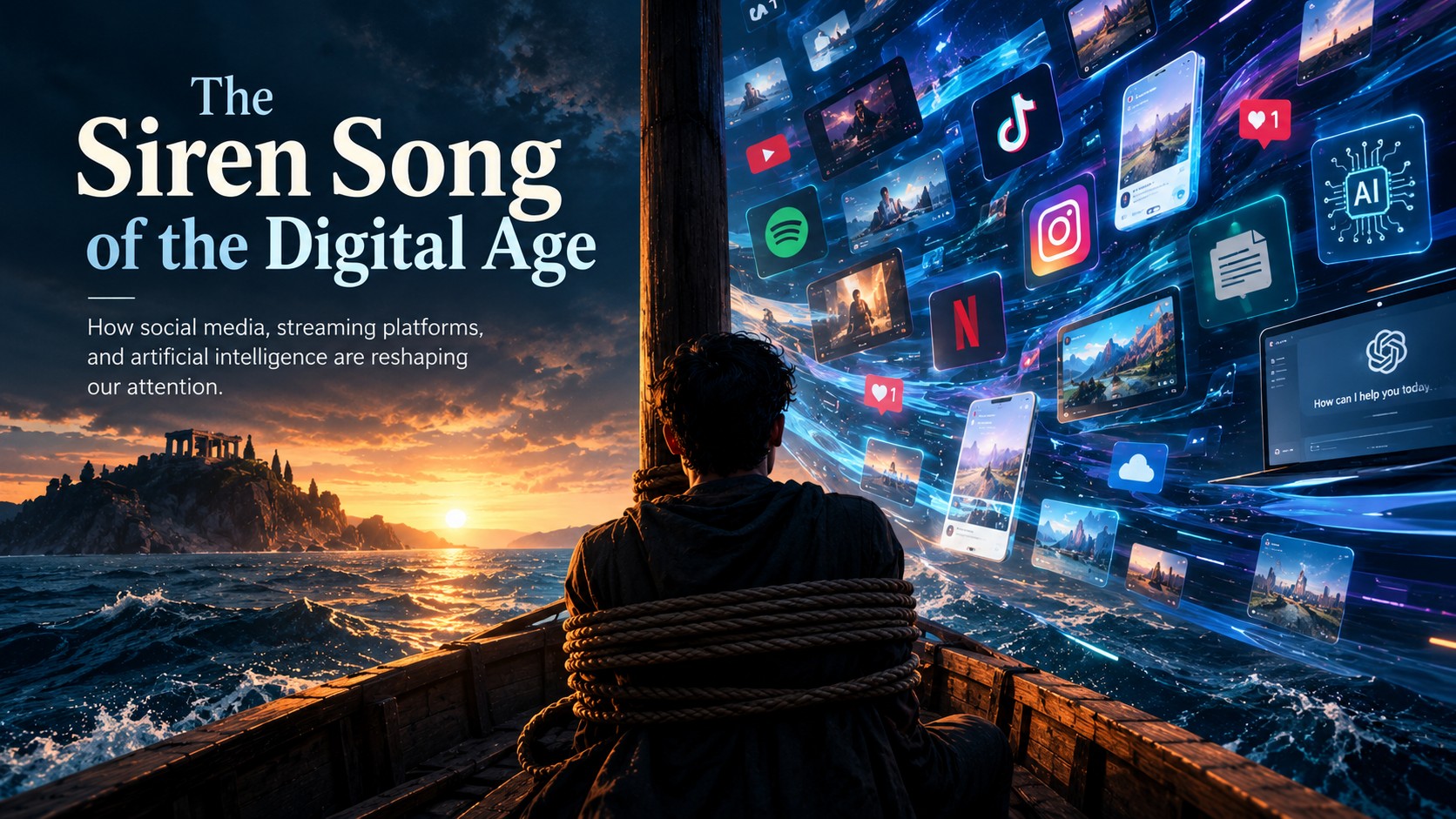
How social media, streaming platforms, and artificial intelligence are reshaping our attention—and perhaps, our ability to create.
In Greek mythology, the Sirens were known for their enchanting voices. Their songs were so irresistible that sailors who heard them would abandon their journeys, lose sight of their purpose, and sail toward destruction.
Odysseus, however, found a way to hear their song without surrendering to it. He ordered his crew to plug their ears with wax and tie him tightly to the ship's mast. He wanted to experience the temptation, but he also understood that his own will might not be enough to resist it.
Thousands of years later, the Sirens are no longer waiting on distant islands.
They are in our pockets.
They sing through our notifications, our social media feeds, our streaming platforms, our endless recommendations, and the digital worlds we enter every day.
And perhaps the most unsettling part is that we willingly sail toward them.
The Modern Siren Song
Think about the last time you opened your phone just to check one notification.
You intended to spend a minute or two. Perhaps you wanted to reply to a message, watch a short video, or look something up. Then another video appeared. Another post caught your attention. One recommendation led to another, and before you knew it, an hour had passed.
Sometimes, we forget to eat on time. Sometimes, household chores remain unfinished. Our responsibilities wait while we continue scrolling, watching, reading, and consuming.
We enter these digital spaces with an intention, but often leave without remembering what that intention was.
We tell ourselves that we are only taking a short break. Yet the break becomes the activity, and the activity becomes a habit.
It is no longer simply about entertainment. It is about how easily our attention can be redirected, how quickly time can disappear, and how difficult it can be to return to the things that genuinely matter.
That is why I find the story of the Sirens so relevant to our time.
The modern Siren song does not need to force us to stay. It only needs to make leaving feel less appealing than staying.
We Are Not Just Consuming Content. We Are Giving Away Our Time.
There is something strange about the way we experience the internet today.
We have access to more knowledge, art, ideas, and information than any previous generation could have imagined. We can learn a language, explore distant cultures, understand complex scientific concepts, and connect with people across the world without leaving our rooms.
These are extraordinary possibilities.
But access to more information does not necessarily mean we are becoming more knowledgeable. Watching more videos does not automatically make us wiser. Reading more posts does not always mean we are thinking more deeply.
Sometimes, we consume information without absorbing it. We move from one idea to another before giving any of them enough time to settle in our minds.
We are constantly stimulated, yet we may struggle to sit quietly with a single thought.
We are surrounded by content, yet we rarely ask whether the content we consume is helping us become the people we want to be.
Perhaps the real question is not how much information we can access, but how much of our limited attention we are willing to exchange for it.
After all, our time is not an unlimited resource. Every hour spent somewhere is an hour we cannot spend elsewhere.
Why Is It So Difficult to Resist?
It would be easy to blame ourselves entirely. We could say that we lack discipline, that we are lazy, or that we simply need more self-control.
Personal responsibility matters, of course. But the environment in which we exercise that responsibility matters too.
Many digital platforms are designed to encourage continued engagement. Notifications invite us back. Recommendation systems predict what we might want to see next. Infinite scrolling removes the natural stopping point that a book, a television programme, or a physical activity might otherwise provide.
The next interesting thing is always just one swipe away.
And because the next reward is unpredictable, we may continue looking for it. Sometimes the next video is ordinary. Sometimes it is hilarious, surprising, informative, or emotionally moving. We keep going because we do not know what the next moment will offer.
The result is a peculiar imbalance: stopping requires a decision, while continuing requires almost none.
This does not mean technology is inherently evil, or that every platform is deliberately trying to harm us. It means we should recognize the difference between tools that serve our intentions and systems that continually compete for our attention.
The Sirens do not have to defeat our intelligence. They only have to keep us listening.
Even AI Has Become Part of the Song
This is where the subject becomes personal for me.
As I write these thoughts, I am using artificial intelligence to help me shape them into a blog post.
I could have written everything on my own. I could have struggled with the wording, searched for the right expressions, developed the metaphor, and created something entirely through my own effort. Perhaps I might even have discovered a way of expressing these thoughts that I would never have found otherwise.
Instead, I turned to AI.
And I have good reasons for doing so. It helps me understand unfamiliar concepts, organize my thoughts, explore different perspectives, and express ideas more clearly. It can make learning faster and creative work more accessible.
I am not against using it.
But I cannot ignore the question that comes with it: At what point does assistance begin to replace our own effort?
If I ask AI to explain a concept I do not understand, it can help me learn. If I ask it to challenge my assumptions, it can make me think more carefully. If I use it to refine something I have already considered deeply, it can help me communicate more effectively.
But what happens if I stop trying to think before asking it to think for me?
What happens if every difficult sentence is delegated, every unfamiliar idea is summarized, every creative struggle is avoided, and every blank page is filled by something generated elsewhere?
Will I become a better thinker, or simply a more efficient consumer of answers?
I do not have a definitive answer. I suspect the difference lies in how we use the tool and what we expect from it.
The irony is that I am using AI to write about the importance of independent thought. I am using a technological tool to question our growing dependence on technological tools.
Perhaps that contradiction is precisely why this reflection matters.
I can use AI to help express my thoughts, but the thoughts themselves must still be examined, questioned, and made my own. Otherwise, I risk producing words without developing the understanding that should give those words meaning.
Convenience is valuable. But not every difficult process is a problem that needs to be eliminated. Sometimes, the struggle is part of how we learn, discover, and create.
Odysseus and the Courage to Set Boundaries
There is one detail in the original myth that deserves our attention.
Odysseus did not rely entirely on his willpower. He knew that, when confronted with the Sirens' song, his judgment might change. So he arranged his circumstances before the temptation arrived.
He made a plan while he could still think clearly.
Perhaps this is the part of the story we need most today.
We cannot always depend on ourselves to stop scrolling at the perfect moment. We cannot expect to resist every distraction while keeping every notification enabled, every platform within reach, and every source of entertainment available at all times.
Sometimes, we need to create our own mast.
It might mean leaving the phone in another room while working. It might mean setting a time to stop watching videos, disabling unnecessary notifications, or protecting the first and last part of the day from endless scrolling.
It might mean reading a book before searching for a summary, writing a paragraph before asking AI to improve it, or spending a few minutes thinking before looking for an answer.
These are small actions, but they change the relationship between ourselves and our tools.
We do not have to abandon technology. We need to stop treating unrestricted access as the same thing as freedom.
Real freedom includes the ability to choose when to engage, when to disengage, and when to walk away.
We Must Not Forget How to Create
There is another cost to endless consumption that concerns me: the possibility that we become so accustomed to experiencing other people's creations that we neglect our own.
We watch other people's adventures instead of exploring our surroundings. We listen to other people's ideas without developing our own. We admire art, writing, music, and innovation while postponing the things we have always wanted to create.
We become spectators of possibilities that we might once have pursued ourselves.
And now, with AI capable of generating text, images, music, and countless other outputs, the boundary between creating and consuming can become even less obvious.
The opportunity is enormous. Someone with limited resources can explore ideas that previously required specialized skills or expensive tools. A beginner can experiment, learn, and bring a project to life.
But we should be careful not to confuse the ability to generate something with the experience of creating it.
Creation involves more than producing an output. It involves making choices, confronting uncertainty, developing taste, learning from mistakes, and discovering what we actually want to say.
Sometimes, the imperfect thing we make ourselves teaches us more than the polished thing a tool produces for us.
I do not want to live in a world where we have access to everything but lose the desire to make anything of our own.
I want to use technology to expand my capabilities, not to surrender the very abilities I hope to develop.
And I think that distinction matters for all of us.
We May Not Be Able to Silence Every Siren
We live in a world where digital technology is woven into education, work, communication, entertainment, and creativity. Completely escaping it is neither realistic nor necessary.
Nor should we romanticize a past in which information was harder to access and opportunities were more limited.
The answer cannot simply be to shut our ears to everything new.
Instead, we must become more deliberate about what we listen to.
We must learn to recognize when entertainment becomes avoidance, when convenience becomes dependence, and when assistance begins to undermine our own development.
We must protect our time for the ordinary but essential parts of life: eating properly, caring for our homes, speaking with people we love, doing meaningful work, sitting with our thoughts, and pursuing ideas that may take weeks or months to develop.
Most importantly, we must preserve the ability to be alone with our own minds without immediately reaching for something to fill the silence.
Because silence is not always emptiness. Sometimes, it is where our own ideas finally become audible.
The Song Will Continue. What About Us?
I began thinking about the Sirens because their story seemed like such a fitting metaphor for our relationship with the digital world.
But the more I consider it, the more I realize that the problem is not simply that the song exists.
The song has always existed in different forms. There has always been something that promises immediate pleasure, effortless answers, or an escape from the responsibilities of ordinary life.
What has changed is the scale, the accessibility, and the persistence of the song.
It follows us everywhere. It learns what interests us. It can fill almost every idle moment.
And sometimes, even when we recognize what is happening, we continue listening.
I am not writing this as someone who has completely escaped the problem. I am writing it as someone who recognizes the temptation and is trying to understand it.
Perhaps that is where we should begin: not with the claim that we have mastered our attention, but with the honesty to admit that our attention is worth protecting.
We can enjoy technology without allowing it to consume every available moment. We can use AI without abandoning independent thought. We can explore the digital world without forgetting the physical one. We can learn from others while still making room for our own voices.
Odysseus did not need to destroy the Sirens to continue his journey. He needed to understand their power and prepare himself for it.
Perhaps we need to do the same.
The Siren song of the digital age will not disappear tomorrow. New platforms will emerge, new technologies will promise greater convenience, and new forms of entertainment will compete for our attention.
The question is whether we will remain conscious of the choices we make while listening.
Because, in the end, the greatest danger may not be that we hear the song.
It may be that we become so accustomed to listening that we forget where we were going.
And somewhere, beneath all that noise, there may still be an idea waiting for us to think it through, a story waiting for us to write it, or a life waiting for us to actually live it.